Half a Million Articles Read on Imar.Spaanjaars.Com!!
I started this site back in September 2003 and only added a few articles during its early stages. I wasn't sure in what direction I should take it, but I decided to publish some technical articles about things I encountered in my professional live as a programmer, a tech lead and a technical author. Back in the beginning, I posted a lot about good ol' "classic ASP but already started to write about ASP.NET 1.0. Obviously, this was soon followed by .NET 2.0, long before it was released in November 2005. And recently I have started writing about the upcoming Orcas release that brings us ASP.NET 3.5; another big step forward in web development.
As my site began to grow, I added a bunch of features that allowed me to see how well the site was doing, including a rating mechanism for articles, and an Article View Counter. Back in 2004, around 60 to 100 articles were read on a single day. Nowadays, this number is much higher with a daily average of around 2,500, peaking to days with more than 5,000 article views.
To put things into perspective, Wikipedia published there 500,000th article in March 2005, Skoda produced their 500,000th Octavia in April 2007 (can't imagine who wants one) and iStockPhoto accepted their 500,000th image in 2005. But, even compared to big names like these, I think 500,000 article views is still an impressive number.
I have been watching the article counter for some time now, each time seeing it getting closer to half a million (!!) article views. But finally, today, it was the day. Quite an achievement for a small site like mine, running on my privately owned server living in my attic. The actual number may be a little higher as I only started tracking article views in November 2004, while the site came on-line in in september 2003 with this article about sending e-mail from an ASPX page.
However, right in the beginning, things weren't so busy over here. The following chart shows how traffic evolved over the past three years (minus a few months) broken down by month, showing the total number of article views:
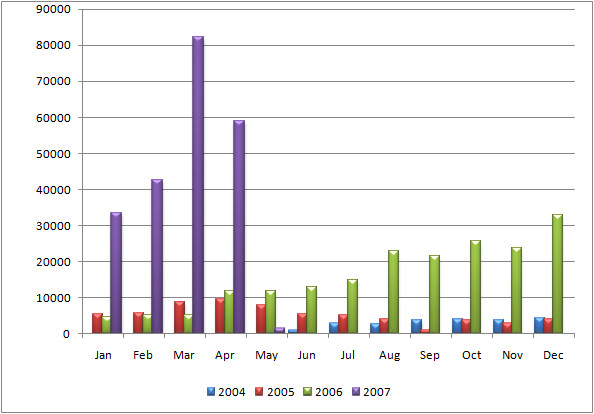
Especially since October 2005, you see a constant growth in the number of people that read stuff on my web site. It's interesting to see how especially during the last four months traffic has increased big time. This can be seen a lot better in the following chart:
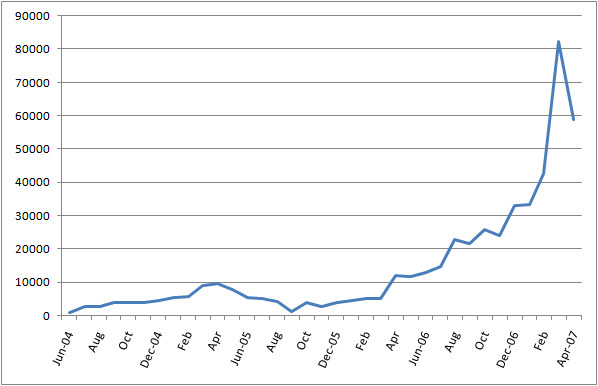
The peak in the article views in the first four months of this year are mainly caused by my article series about N-Layer design. The three articles combined have been read well over 55,000 times, contributing more than 10% of the total number of article views.
Oh, and that dip in September 2005? That's my server being down for weeks due to hardware failure.... ;-)
Some Other Interesting Figures
If you have a site like mine up and running for a couple of years, and collect data like a squirrel (that is, collect a lot, loose half of it), you can come up with some interesting statistics. Here are just a few:
| Number of articles read (excluding Search Engines) | 500,000 (and counting) |
| Number of articles indexed by well-known search engines | 67688 |
| Unique IP Addresses that visited my site | 189647 |
| Busiest day ever | March 7 2007, with 5800 article views |
| Number of comments posted by visitors | 1037 |
| Number of comments answered by me | 578 |
Most Popular Articles
Obviously, when looking into the past, it makes sense to look at the most popular articles. I don't keep a running list of popular articles on my site, as I believe they leads to a self-fulfilling prophecy. With such a live list, articles become more popular, simply because they were popular in the past, and people are curious to see what they are about.
However, now is a good moment to see what made Imar.Spaanjaars.Com so popular in the past three years. Here's a list of the 10 most popular articles with the number of views between parentheses:
- Passing Multiple Parameters to a Crystal Report Programmatically (34339)
- Building Layered Web Applications with Microsoft ASP.NET 2.0 - Part 1 (23906)
- How Do I Fix ASP 80004005 errors? (21573)
- Configuring an ASP.NET 2.0 Application to Work with Microsoft SQL Server 2000 or SQL Server 2005 (16855)
- Building Layered Web Applications with Microsoft ASP.NET 2.0 - Part 2 (15721)
- Building Layered Web Applications with Microsoft ASP.NET 2.0 - Part 3 (15628)
- How Do I Add a Client Side Message Box to ASPX Pages? (15529)
- How Do I Determine the Security Account that IIS Uses to Run My Web Site? (15030)
- Storing Uploaded Files in a Database or in the File System with ASP.NET 2.0 (12923)
- Using the Microsoft Access Providers to Replace the Built-In SQL Server Providers (12000)
Again, it's interesting to see how my n-layer articles made it to the top 10 so quickly, considering they have only been on-line for a couple of months.
The article about Crystal Report parameters is firmly located on the number one spot. At the same time, it's *the* article I wished I'd never written, as it seems to attract the most off-topic comments from all articles. I think it's about time I build a "Comments for this article are now closed" feature, for that article alone ;-)
The least popular articles are a little difficult to track. There are a large number of articles on my site that are not publicly available which have received only a few hits by visitors with an account to my site. In general though, articles with the lowest number of hits tend to fall in the category "site news" that announce new articles and new features. It makes sense that they are the least popular, as it's content that is king, not irrelevant information about that content.
Fortunately, most of the articles with a high visit count, also receive good ratings. Here are the articles with the highest user ratings that received at least 10 votes. The number in parentheses is the average rating, on a scale from 1 to 5.
- How Do I Select Duplicate Records from a Database Table (4.94)
- Using Attributes to Improve the Quality and Usability of Your Code Part 1 - Decorating Business Objects for Data Binding (4.90)
- Why Do I Receive a "The page cannot be found" Error With ASP.NET On Windows Server 2003? (4.90)
- Retrieving the Parameter Marker Format When Using Generic Database Factories (4.87)
- Why Don't I See a Security Tab on the Properties dialog for My Files and Folders in Windows XP? (4.86)
- Building Layered Web Applications with Microsoft ASP.NET 2.0 - Part 3 (4.82)
- Configuring an ASP.NET 2.0 Application to Work with Microsoft SQL Server 2000 or SQL Server 2005 (4.81)
- Using the Microsoft Access Providers to Replace the Built-In SQL Server Providers (4.79)
- Howto Create a Microsoft Access Database from ASP Code (4.72)
- How Do I Determine the Security Account that IIS Uses to Run My Web Site? (4.72)
- Building Layered Web Applications with Microsoft ASP.NET 2.0 - Part 2 (4.71)
-
How Do I Set the DefaultFocus or DefaultButton in a Page Based on a Master Page in ASP.NET 2.0? (4.64)
4.64 - Howto Use Embedded Images in a Pocket PC Application (4.63)
- Building Layered Web Applications with Microsoft ASP.NET 2.0 - Part 1 (4.58)
- How Do I Add an Additional Item To a Databound DropDownList Control in ASP.NET? (4.53)
Again, it's good to see a recent addition to the site - the article series about n-layer design - to be so highly rated.
Well, I think that's enough numbers about this site to get everyone bored except for driven mathematicians, so I'll leave it to this.
All Because of You
All these numbers have been made possible by you: the reader of Imar.Spaanjaars.Com. It's good to see that what I write means something to those who read it. That's what makes it worth writing in the first place.
So, thank you all, and keep visiting Imar.Spaanjaars.Com
Imar
Where to Next?
Wonder where to go next? You can post a comment on this article.
Links in this Document
| Doc ID | 427 |
| Full URL | https://imar.spaanjaars.com/427/half-a-million-articles-read-on-imarspaanjaarscom |
| Short cut | https://imar.spaanjaars.com/427/ |
| Written by | Imar Spaanjaars |
| Date Posted | 05/01/2007 22:10 |
Comments
Talk Back! Comment on Imar.Spaanjaars.Com
I am interested in what you have to say about this article. Feel free to post any comments, remarks or questions you may have about this article. The Talk Back feature is not meant for technical questions that are not directly related to this article. So, a post like "Hey, can you tell me how I can upload files to a MySQL database in PHP?" is likely to be removed. Also spam and unrealistic job offers will be deleted immediately.
When you post a comment, you have to provide your name and the comment. Your e-mail address is optional and you only need to provide it if you want me to contact you. It will not be displayed along with your comment. I got sick and tired of the comment spam I was receiving, so I have protected this page with a simple calculation exercise. This means that if you want to leave a comment, you'll need to complete the calculation before you hit the Post Comment button.
If you want to object to a comment made by another visitor, be sure to contact me and I'll look into it ASAP. Don't forget to mention the page link, or the Doc ID of the document.